Ground driving is an excellent way to teach a green horse about
bit pressure and how to steer, stop, and back up. It can be done with younger horses that aren’t
physically developed enough to start riding.
I like to take a few days to work on ground driving before the first
ride. That way, when I get on, the horse
already knows how to respond to bit pressure (and the horse already knows how
to go forward from my voice, from earlier ground lessons). On the first ride, the only new thing the
horse is going to experience is a rider on their back and leg pressure on their
barrel.
 |
| Here I am driving Copper from behind, using the western saddle's stirrups to hold the driving lines. |
What do you need?
·
Driving lines or two similar lunge lines
·
Western saddle or surcingle
·
Snaffle bit
·
Whip (if vocal cues aren't enough)
What is it?
Ground driving is exactly what it sounds like. The handler “drives” the horse by walking on
the ground instead of riding in a cart.
Ground driving is also called long lining by some trainers. There are two methods of ground driving:
walking behind the horse or driving the horse on a circle.
Driving from Behind
The first is the easier of the two to get the hang of and it
offers more versatility. Because you are
following the horse, it is easier to keep them from turning around and facing you and getting
twisted in the lines. You can also do
more exercises such as weaving cones, figure-8, stopping, and backing up. The main downside of this method is that it
is more taxing on the trainer, as the trainer has to move at the pace of the
horse. Because you are following the
horse, you need to pay attention to your proximity to the horse.
You don’t want to be in range if the horse decides to kick out.
 |
| Traveling Straight |
 |
| The beginning of a right turn. |
To drive from behind, the horse can be tacked up in a
western saddle or a surcingle. The
western saddle will place the reins in a “low headset” position so it is not
ideal for horses that naturally carry their heads/necks higher. The surcingle will have three or more rings
on each side, ranging from a “high headset” to about level headset. When I drive a green horse from behind, I
typically thread the lines through the lowest ring on the surcingle. The bridle should be fitted to the horse
normally and the lines should be attached to the bit on each side and then run
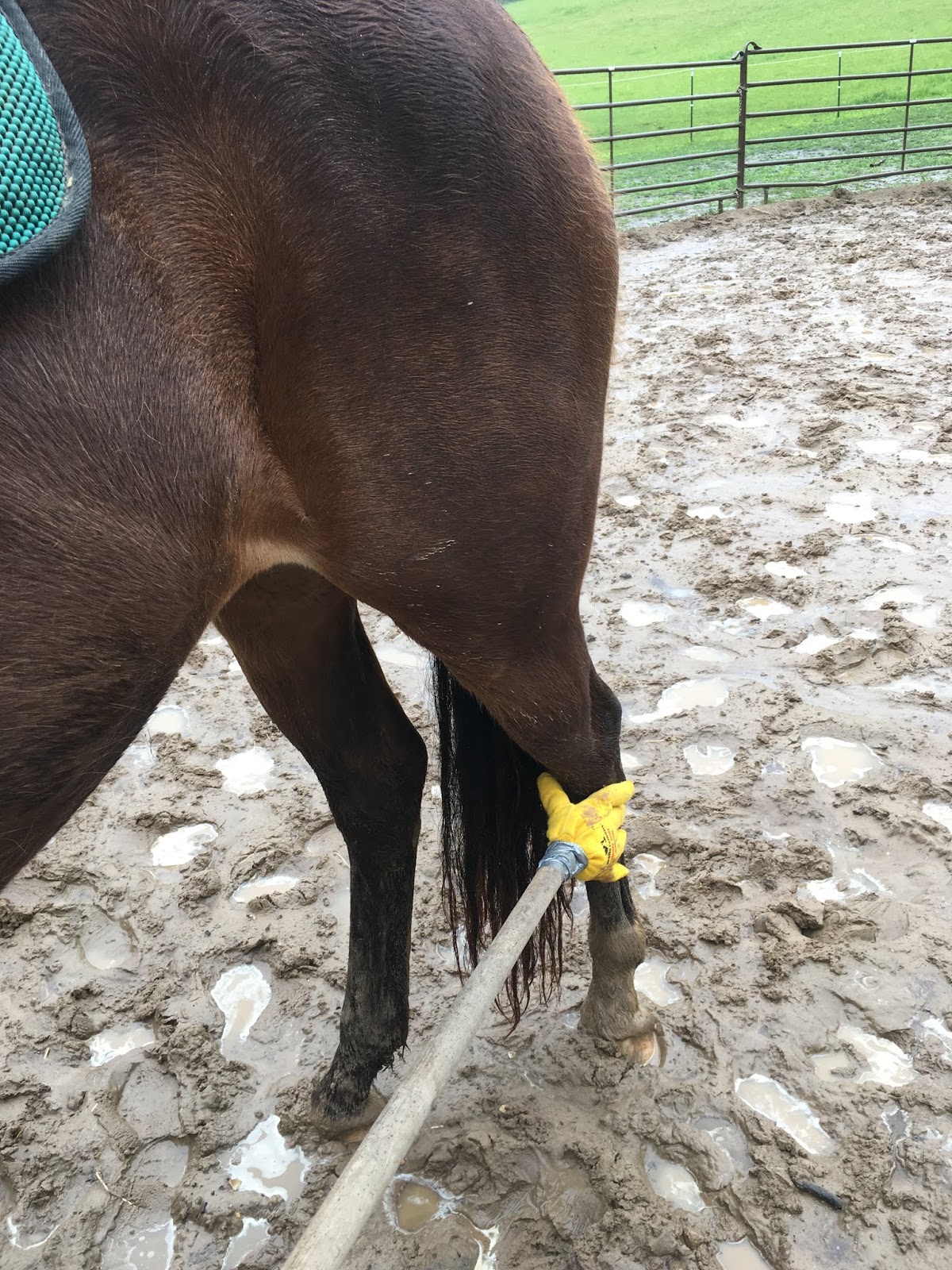
through the stirrup or desired ring on the surcingle. Tying the stirrups together underneath the
horse will keep them in place while turning.
When your lines are in place, stand behind the horse and encourage them
to move forward either through voice commands or the whip (tap on the
rump). Once the horse is moving in a
forward direction, you can ask for turns.
If the horse stops when you ask for a turn, use more forward
encouragement. Once the horse gets the
hang of turning, you can practice stopping and backing up. Reinforce the bit pressure with a verbal “whoa”
and release pressure on the reins as soon as the horse stops moving forward
(stopping) or at each step backwards (backing).
Driving on a Circle
Driving on a circle involves standing in the middle of the
circle while the horse travels around you, similar to lunging. In this method, you can have the horse both
trot and canter with very little effort on your part. The downside is that there is not much variety
here and the horse can only be reversed by
turning to the outside. This can be
confusing at first for the horse because they are used to turning to the inside
during lunging exercise. To add variety, practice changing between gaits, asking the horse to respond quickly to your cues. You can also set up ground poles around the circle to help the horse regulate his stride and cause him to lift his legs higher (this strengthens the back muscles).
There are two
ways that you can run the driving lines: behind the hocks or over the
back. Behind the hocks can be done with
a surcingle or a western saddle. Over
the back can be done with a surcingle.
Driving over the back is a little trickier because as you reverse the
horse, you will need to flip the line that is becoming the outside line
over the horse’s rump and up on the back.
The main thing you need to watch when having the lines around the hocks
is to not get to much slack when turning, or the horse could step over the
line. To turn, gather up more of the outside line as you release some of the inside line. If your outside line is too long when he turns, he may end up stepping over the line once he is turned around. Pull on the outside line and guide the horse as he turns away from you. Make sure you have enough slack in your inside line so that he is able to turn away. As he rejoins the circle traveling the opposite direction, adjust your lines so they are the right length. Driving on a circle takes a little practice to get the hang of it, but it can be a helpful tool for training and exercising your horse.