Thursday, January 21, 2021

Training Horse Profile: Luna

 Training Goals:

  • Comfortable with basic handling
  • Ground Work
  • Picking up feet
  • Started under saddle
Luna is a 5-year-old Saddlebred.  She is originally from Utah, where she was a broodmare, and was recently brought to IL with her foal at her side.  Since she hadn't had much handling, her owner's main priority it was to get her comfortable with basic handling and groundwork, while working towards riding.

One known issue she had was allowing her feet to be handled.  She stood well for the farrier as a two-year-old, but now could only be trimmed if she was sedated.  One of the goals was to help her overcome her nervousness about her feet being handled, so that she can be trimmed safely without sedatives.


Day 1: Luna is still settling in so today's training will be pretty basic.  She didn't want to be caught at first so I moved her around the round pen for a little while.  She was a bit jumpy but settled down once I caught her.  Worked on yields, lunging, and desensitizing with the whip.  She catches on fast.  She was quite scared of the whip at first, but stood well after awhile.

Day 2:  Reviewed yields, lunging, and desensitizing with the whip.  Added swinging the whip around her and over her back.  Introduced saddle pad.  Shied away/trembled at first but got fairly comfortable.  Attempted to put on the bridle but she raised her giraffe neck out of reach each time so we switched to working on lowering the head and neck from halter pressure.  Resistant at first, but caught on quickly.

Day 3:  It was a busy morning on our property and a lot of commotion.  With the tractor, weed eater, and skid loader all running at once, I was expecting Luna to be very distracted and jumpy.  Surprisingly, she was the most relaxed she has been thus far and I was able to quickly get through everything I had planned on doing, plus more.  She was fine with the whip touching her and swinging around her and much more comfortable with the saddle pad.  With the help of molasses rubbed on the mouthpiece of the bit, I was able to get the bridle in her mouth on the first attempt.  I worked with her on lunging over ground poles, forehand and hindquarter pivots, backing off halter pressure, and lowering head from halter pressure.

Desensitizing with the Flag

Day 4:  It was super windy today but Luna passed the reviews of yesterday's lessons.  Introduced her to the surcingle, which she didn't mind on her back but was uncomfortable with it tightening around her middle.  It took a little while to get on as she kept moving.  Began to teach her to ground drive, which she was not a fan of.  The slightest bit pressure caused her to panic and bolt, which made the lines move more, which made her run harder.  She did eventually settle down and would move around the circle calmly as long as I didn't ask her to change directions.

Day 5:  Worked on ground driving again.  She was more nervous about it than the previous training session.  At one point, she attempted to run through the round pen panel, so I called it quits on that and returned to other exercises that she was more comfortable with.

Day 6: Taking a break from ground driving to work on other areas.  I will revisit ground driving later and hopefully after more handling, she will be able stop and think instead of panicking immediately.  Worked on some more desensitizing using a plastic bag on a lunge whip (which caused her to momentarily think she was going to die), and a noisy jug with rocks.

The VERY SCARY Plastic Bag

Day 7:  Saddled her up for the first time.  She didn't mind the saddle on her back but was very uncomfortable with the cinching part.  I only had her on my short lead, which turned out to be a mistake, because when she took that first step after the saddle was secured, she flipped out!  I, for one, prefer not to be that close to a horse that is full-on bronc trying to get the saddle off.  I didn't dare let go of the lead as she had already tried once to go through the round pen panel.  After a few sketchy moments, I was able to get her to stop and quickly switched out my lead for the much longer lunge line.  I sent her out in the circle and she immediately began bolting and bucking.  After a few rounds, she realized that the saddle really wasn't going to hurt her and she settled down.  Once she was completely calm about the saddle while lunging, I did additional desensitizing exercises with the saddle.

Lunging with the Saddle

Day 8:  Continued to desensitize her using the bag.  Took the saddle on and off several times as she can be a little nervous about that.  Lunged her with the saddle on at the walk and trot.  She did much better and only had a short random bucking episode.

Day 9:  I was finally able to rub the plastic bag on her face and slap it underneath her legs without her panicking!  I again took the saddle on and off several times and lunged her at all three gaits.  She had a short bucking episode the first couple times I asked her to canter, but otherwise she lunged quietly.

Day 10:  While Luna was free in the round pen, she spooked at something and bolted straight for the side and attempted to jump the panel.  Thankfully, she did not injure herself, and the round pen mostly survived.  This horse definitely could have a jumping career in her future!

Days 11-15:  Last week was a lot of stimulation, so this week I am giving Luna a bit of a break and working more on basic groundwork.  She can be very resistant to moving her hindquarters away from pressure.  I like to teach horses to move away from both steady pressure (hand on hip) and intermittent pressure (tapping of a whip or swinging a rope).  She has a tendency to threaten to kick when asked to do this, so it was definitely something I wanted to address.  Also worked on getting her to lead into a stall to build trust.  Introduced her to the tarp, which she had no issues with.  Go figure!

Everything is scary...except this tarp.

Day 16:  Finally got her to follow me into the stall!  Saddled her again, put the bridle on, and lunged her.  Also began working on getting her comfortable with picking up her front feet.

Day 17:  Followed me into the stall with only slight hesitation.  Saddled, bridle and lunged her- only a few bucks.  Manually began working with her to give to bit pressure.  Most horses do not need this exercise and learn quickly from ground driving, but Luna was in too much of a panic for that to work well.  For manual flexing, I stand at the shoulder apply light pressure on the bit to ask the horse to flex toward me.  I do this on both sides.  I can also apply pressure on both sides to ask the horse to back up.  She panicked a little at first, but with well-timed releases, she quickly caught on and started giving to the pressure much more quickly.  Continued to work on handling her front feet and more saddle desensitizing.

Day 18:  Luna is completely comfortable leading in and out of the stall.  Today, for some reason, she was moving all over the place for saddling, but once she was saddled she lunged quietly at all gaits.  Continued to work on saddle desensitizing.  Worked with her front feet.  She also showed improvement with the bit exercises.


Day 19:  Worked on front feet.  Saddled, bridle and lunge all three gaits.  Introduced indirect bit pressure-- instead of turning her towards me like I have been, now I reached over her neck and asked her to flex away from me.  This was much more challenging for her.

Day 20:  Started working on her hind feet.  Since she has already kicked at me once, I started by using a rope to lift her hind feet, so I could stay by her shoulder.  Continued to work on the other groundwork exercises.

Day 21:  Luna's owner visited today.  I showed her everything we've been working on so far and we discussed the training plan moving forward.

Day 22:  My new side reins finally showed up so I introduced Luna to those today.  I am starting by using each side rein separately.  This way she can feel a little tension and weight on the bit on each side, while it gives her a little more freedom to move her head.  My goal is to continue to increase pressure gradually so she can learn to give into the bit, while hopefully avoiding a panic.  Continued to desensitize her to saddle noises and introduced her to some weight in the stirrup.  Also worked on hind feet.

Day 23:  Worked on applying weight in the stirrup with my foot and introduced her to a little one-legged hopping.  She actually didn't mind that too much.  Used the side reins together and worked on her hind feet.

Day 24:  Introduced Luna to the bridge.  She quickly stepped on with her front feet, but it took awhile to get her back feet on and to walk all the way across.  Used the side reins again with a little more pressure.  Put my weight on her back by laying over her.  I was also able to stand briefly in the stirrup and I was able to pick up both hind feet!

Luna on the Bridge

Day 25:  Luna is doing much better with picking up her hind feet when asked without kicking or moving away.  Now that she typically picks them up each time she is asked, I am working on increasing the duration I expect her to keep the foot up.  The other task we focused on was desensitizing her to a rider stepping up and down in the stirrup.

Day 26: Continued to build on yesterday's progress on picking up her hind feet and stepping up and down in the stirrup.  Also worked on some saddle desensitizing to get her used to the variety of noises that can occur with a rider in the saddle.  Some exercises I like to do with spookier horses before the first ride are: flopping the stirrups against the sides, smacking the saddle seat, wiggling the saddle, jerking down on the stirrups in quick succession, etc.

Day 27:  More repetition of picking up the hind feet and standing in stirrup.  Tested Luna's spook threshold by lunging her with plastic bags tied to the saddle.  She did better than I expected and it didn't take her long to get used to the noise.  With most horses, I just tie the noisemakers to the saddle with a piece of twine, but because Luna has demonstrated a knack for panicking, I did it a little differently.  I used a quick-release type knot to attach the bag to the saddle with a long lunge line.  If necessary, I could pull on the line, and the noisemaker would release from the saddle.

Day 28:  Worked on standing in the stirrup for longer periods of time.  She is doing great with that and will stand quietly most of the time.  Continued to desensitize her with noisemakers on the lunge line.  Tied the plastic bag to the saddle horn so the noise was behind her head and difficult to see.  Introduced her to the bottle of rocks and lunged her with it hung on both sides.

Plastic bottle of rocks
with the panic release line.

Day 29: Attempted ground driving again and she did so much better!  She gave to the bit and turned when I asked her, without bolting or fighting it.  I stood in the stirrup several times for several seconds and she stood quietly.  She has finally passed all of the tests, and tomorrow it's time to get in the saddle for the first ride!

Day 30:  First ride went really well.  When I first got on, she backed up and it took a little while to get her to just stand still.  I was able to get her to walk around and surprisingly she didn't spook or bolt.

Day 31:  Second ride.  Worked on turning, stopping, and backing.  She refused to go on the east side of the round pen for some reason and kept looking very attentively into the alfalfa field.

Day 32:  Today's ride went better with turning and with using the whole round pen.

Day 33:  First trot!  She did great and didn't attempt to buck.  

Day 34:  Continued to work her at the walk and trot and improved bit response for turning, backing, and stopping.

Barrels are great to make
flat work more interesting.

Day 35:  Last night we moved our geldings from the home pasture to the dry lot near the round pen.  Luna was obviously more distracted today with keeping an eye on their movements.  She was also spooked by something in the alfalfa field and again wouldn't go on the east side of the round pen (closest to the field).  Even with these difficulties, she cantered 3 strides!

Day 36:  Luna is improving so much.  She cantered a few strides in each direction and only had one small buck once when getting into the stride.  She was a bit peppy this morning and it took awhile to settle into a nice trot rhythm.

Day 37:  The morning started out well.  Luna lunged responsively, picked up all her feet well, and stood fairly well for saddling.  Once we were riding, she walked nicely and started trotting until suddenly getting very agitated and not wanting to move forward.  She offered to buck when pressed to move and did not want to flex to the right.  I worked on small circles and moving her forehand off of leg.  Eventually, we worked through her issue and we were able to trot around.

Day 38:  Luna is cantering so much better on the left lead but is really struggling with the right lead.

Day 39:  A friend helped me today by taking some videos of me riding Luna to try and assess some issues under saddle.  Video can be extremely helpful with seeing things that are more difficult to see when you are on the horse.  Luna cantered well on the left lead but really struggled with the right.  When asked to canter on a clock-wise circle, she is pinning her ears, swishing her tail, and swinging her hip into the inside.  She does not exhibit these behaviors on the lunge line.  She did well with hindquarter and forehand pivots.

Day 40:  Luna was feeling a little sluggish and it took a lot of encouragement to get her cantering.  She was able to maintain a longer left lead canter, but she was about the same for the right lead.  Worked on forehand and hindquarter pivots, trotted nicely.  Started working on side passing.

Luna, ready for a ride.

Day 41:  Picked up all four feet, all well except right hind she's a little less comfortable with.  Worked on pivots and side passing and walk/trot.  She cantered her best so far!  She picked up the left lead quickly and sustained it longer.  The right lead was a bit sideways, but she picked it up more easily and sustained it longer.

Day 42:  Got quite a bit of rain over the weekend, so the ring was too sloppy to work on the canter.  Lunged her first and then worked at the walk and trot.  Continued to work on pivots, side passing.  Her head position is improving as she is giving more to the bit, lowering her head and not pushing against my hands.  Took her for her first pasture ride and she did great!

Day 43:  Temperature got colder last night so the ring was a little crusty this morning.  It was hard enough that it wasn't safe to canter as it was difficult for her to get a good grip.  Lunged her and then worked her at a walk and trot.  Reviewed pivots and side passing, which was much better.  Worked on getting her to lower her head off the bit.  Rode again in the pasture.

Day 44:  I dislike when it is super windy, but it did help dry out the arena footing and it was safe to work her at all gaits.  We reviewed pivots and side passing (which she did great!).  She was feeling a little spritely and had a few small bucks at the canter.

Day 45: It was windy again and not surprisingly, Luna was a stinker to catch.  Thankfully, that was her only issue.  She stood well for saddling, lunged well, warmed up perfectly at the trot.  She showed more progress at the right lead canter and was great on the left lead.  We headed out to the pastures and then headed out for a trail ride.  She was nervous about going someplace new and did plenty of looking around, but overall she did very well.

Day 46: She was a little challenging to catch again, but it didn't take quite as long as yesterday.  I warmed her up on the lunge line and then picked up all four feet.  She has come such a long way on these and picked them all up nicely and allowed me to pick them out.  She also stood well for saddling.  Under saddle, we worked on side passing, pivots, transitions, sitting trot and posting trot.  She cantered great on the left lead and good on the right lead.  Worked on side pass, pivots, transitions, sitting trot, posting.  We even had a brief moment of excitement.  While moving around the circle, she spooked/bucked, causing me to bump the back of her neck with my hands quite suddenly.  Immediately, she became a rodeo bronc and for a moment I wasn't so sure how I was going to end up.  Thankfully, she was easy to get back under control, and we continued on our circle like nothing had happened.  After some experimentation, I confirmed that she did indeed have a very sensitive neck and patting it firmly produced a very strong reaction. We spent the rest of the session desensitizing her to pats on the neck until she no longer reacted to it.

Day 47:  Luna goes home today!  I saddled Luna up and when her owners arrived I ran through all of the things we'd been working on.  Luna cantered gorgeously on the left lead, and even had a pretty decent right lead.  She showed off really well and I am so pleased with how far she came.  Her last task of the day had arrived: the trailer.  She had only been in a trailer a couple of times and it had taken awhile to get her loaded to bring her to me.  We decided to prioritize the other training areas, so I had not worked with her on trailering either.  She was hesitant of the trailer but got halfway in several times.  Her owner was very patient and worked on coaxing her with grain but Luna refused to go in any further.  At the owner's offer, I took over, and after about 5 minutes, Luna followed me into the trailer.  This is an example of the bond of trust that can form between a horse and trainer when training is done kindly and patiently.

The weather is getting colder, so the arena footing is starting to get hard and slick.  This November has been extremely mild and dry, which gave me the opportunity to work with her much longer than most years.  We even had a week of 60+ degrees.  I think that was probably the first time I have ridden in short sleeves AND still broke a sweat in NOVEMBER.  It was crazy, but I was so grateful for it!  

Luna had a few hiccups in the beginning but she really came a long way.  It was evident that she learned best when I took things extra slow, and I appreciate that her owner prioritized Luna's comfort and readiness over fast results.  I look forward to hearing Luna and her owners accomplish in the years to come!


Friday, December 4, 2020

Training Horse Profile: Scootch

 Training Goals:

  • Desensitize
  • Standing for mounting
  • Build confidence under saddle
Scootch is a handsome 7 year-old Quarter Horse gelding that has been a pasture ornament for most of his life.  He has had some previous training prior to his new owners, but the extent of his training under saddle is unclear.  One issue is that he bolts away when a rider tries to mount.  He has a very sweet personality, but is a bit over-reactive and spooky.  The training objectives are to reduce his spookiness and to help him gain confidence with a rider in the saddle.


Day 1-5: I began with basic ground work exercises to build a relationship with him and to see what he already knew.  He lunges excellently and stops quickly on 'whoa'.  He will trot on command, but is a little reluctant to canter without the presence of the whip.  I also worked on forehand and hindquarter yields, and lowering the head from halter pressure.  These exercises seemed new to him and he was somewhat resistant at first.  A few treats helped him understand the concept of lowering his head and he was much quicker to respond after that.  He takes the bit amazingly and was a pro at ground driving.  Since he is reactive to a rider trying to mount, I worked on desensitizing him to weight in the stirrup by applying pressure with my hand.  This allows me to easily control the amount of pressure on the stirrup and I can more easily move with the horse, rather than hopping around on one foot.

He tends to spook when the saddle makes any different noises, so much of the week was spent on desensitizing.  I attached a plastic bottle with a few rocks to the saddle and lunged him.  As he moved, the rocks rattled in the bottle and the bottle bounced against his flank.  Once he was lunging calmly, I moved the bottle to the other side.  I repeated this exercise using plastic bags.

Desensitizing to noise using a bottle with rocks.
Day 6-9: I reviewed the desensitizing exercises from last week and he was no longer phased by all the noise.  Now that he stands well during all of the various saddle desensitizing, I began putting weight into the stirrup with my foot.  Last week, he had become comfortable with pressure in the stirrup when it was applied by my hand but he was much more leery when my foot was in the stirrup.  He made slow progress and by mid-week I could briefly stand in the stirrup.  Unfortunately the progress was short-lived and by day 9 he reverted back to his old response.

Day 10: My usual approach to getting a horse comfortable with the mounting process just wasn't making any real progress with Scootch, so after the advice of a very experienced trainer, ("sometimes you just have to cowboy up and get in the saddle"), I decided to give it a go.  It took a few tries, but by keeping his nose flexed to the stirrup, I was able to ride out his spook and get into the saddle.  It took a few minutes for him to calm down and stand still.  If I let him straighten his neck, he would try to bolt, so I worked him in small circles in both directions.  By the end of the training session, he would stand calmly as long as his nose was flexed.

Desensitizing to noise using plastic bags.
Day 11: To help Scootch feel more positively about a rider, I am giving him a treat after I mount.  This should help him look forward to having a rider in the saddle instead of being anxious about it.  We also worked on riding in bigger circles and turning.  He was a bit calmer and only tried to bolt a few times.

Day 12: Today, Scootch stood still for mounting on the first try!  He also walked around the arena calmly and did not try to bolt.  Progress!

Day 13: His owner visited today so we demonstrated all of the skills we have been working on.  Scootch performed well at lunging, yields, ground driving, and pulling a sled.  He stood for mounting and did not try to bolt while riding.  He had some difficulty getting going from a halt, but overall he had a good day.

Day 14: We had a longer training session yesterday and Scootch was such a good boy, so we are going to take it a little easier today.  We reviewed ground work exercises, pivots, and flexing.  

All Saddled Up
Day 15: Today, Scootch decided he had learned his lesson about standing still for mounting to mean don't move at all with a rider!  I could not get him to move his feet.  At this point, I want his riding experiences to be extremely positive, so I wasn't willing to increase the pressure too much.  Instead, we worked on flexing and backing.

Day 16: He is standing so well for mounting.  Yay!  We practiced lots of backing but he refused to move forward.

Day 17: Increased the pressure today in an attempt to get Scootch unstuck.  It made him agitated and frustrated but did not result in forward movement.  New plan for tomorrow!

Day 18: Since Scootch is very responsive to the whip while lunging, I had a friend help me by standing in the center of the arena with a whip.  I asked Scootch to walk and after 3 asks with no response, my helper lifted the whip to encourage him forward.  After several repetitions of this, Scootch was beginning to respond to the leg pressure.  Hopefully, he will remember this lesson tomorrow when I don't have a friend around to help.

Day 19:  Scootch remembered his lesson from yesterday, but would only take one slow step at a time.  My legs sure were tired by the end of the session, but at least we had forward movement!


Day 20: Some improvement today.  It took awhile to get him going, and at first he would only take one step at a time.  Then, he started only walking sideways. Finally, by the end of the session, he was moving forward in straight lines.

Day 21: Scootch was so much better at walking straight today.  Making progress!

Day 22: Excellent ride.  Used barrels to mix things up and to improve his turning.

Day 23: Another great ride.  Continued to work with the barrels and improving his response to cues.

Day 24: Trotted today! I did not expect to get this far with him in the time that I have.  His trot is very comfortable and with more training, it will be a-ma-zing.

Day 25-27: Continued to work on improving his response to leg and bit cues and get more control over his steps.  He has made so much improvement and is so much calmer during the rides.

Day 28: Scootch goes home today!  He impressed his owners with his improvement and they are excited to see where he can go from here.

Relaxing after a good training session.
Scootch was a lot of fun to work with once I figured out the best training approach to use with him.  He has such a sweet personality and willing spirit.  He was a lot of fun to ride and was so responsive to my cues towards the end of his time with me.  This guy has a ton of potential and I look forward to seeing what he can do with the right rider!


Wednesday, September 16, 2020

Training Horse Profile: Babe the Clydesdale

Training Goals:

  • Riding
  • Driving Prep
  • Feet
Babe is between two and three years old.  Her new owners had purchased her about a month prior to bringing her to me and not much is known about her history.  While she had not had much handling, she was sweet and cooperative throughout training.

Her feet were extremely overgrown when she arrived and her owners were not sure if she had ever been trimmed.  The first week was primarily spent getting her comfortable with having her feet handled and getting her ready to have her feet trimmed.  Once a few inches were taken off of her hooves, she was able to move much more easily and comfortably.

Besides riding, her owners also plan to drive her, so I am doing some preliminary training to get her ready to be hitched to a cart.  Once she is back home, they have some friends who are knowledgeable teamsters to help with cart training.


Day 1-9:  The first week was spent doing basic ground work.  She picked up lunging very quickly.  A whip was necessary most days to get her moving as she prefers standing over moving.  She stood like a seasoned horse during all of the desensitizing exercises and was not phased by the saddle.  She also learned how to pick up her front feet and stand still for trimming.

She could not have cared less about the pad.

Day 10:  Today was Babe's first ride!  She did awesome and had no problems with a rider on her back.  If she was any taller, I would need a mounting block.

Day 11:  Two days off for the weekend had no effect on Babe's response to her 2nd ride.  She was calm and relaxed like she had been doing this forever.  With help from a crop, she even trotted around with no funny business.

All Saddled Up

Day 12: To work toward her owner's goal of driving, I hooked up a sled for Babe to drag around the arena to get her used to hearing something behind her.  She was interested in what was behind her but it did not cause her to spook.  She pulled the sled at the walk and trot both directions.  Under saddle, she walked and trotted and turned with less resistance.

Ground Driving

Day 13: Babe's owner visited today to see her progress and she did everything I asked beautifully!  She demonstrated all of the skills she has learned so far and her owner was very excited to see her pull the sled.

Day 14-17: Now that Babe has had a few rides in the arena without issues, it is time to venture out into more wide open spaces.  First, I rode her in the small pasture.  Other than trying to grab a snack, she was as well behaved as she was in the arena.  Then, I moved on to riding in the large pasture.  This took her further away from her buddy (she didn't seem to mind, but he did!) and she went up and down steeper hills. 

Pasture Rides

Day 18 & 19: Babe started being stubborn about lifting her front feet.  When I go to pick up her foot, I can feel her shift all of her forehand weight onto that foot, making it impossible to pick up.  To correct this, I used the handle end of a crop to tap the fetlock.  I increased the intensity of the tapping until she picked up that foot.  After a few repetitions of this, she picked up her front feet as soon as I asked.  I also worked a lot with her on holding up her back feet.  She is pretty good about lifting her hind feet when you ask, but she doesn't like to keep them lifted.  

Day 20: Worked on improving turns and backing under saddle.  Continued to work with her on picking up her hind feet and holding them up.

Flexing

Day 21: I put the barrels out in the arena to give me more variety with the arena exercises.  A few exercises that I like to do with the barrels are: figure 8's, weaving, and small circles.  I also did some desensitizing in the saddle using a small flag.  She was mildly uncomfortable when I waved it over the top of her head but otherwise stood calmly.  She also crossed the wooden bridge over the creek without hesitation and we went for a short trail ride through the woods.

Day 22: I took her across the bridge again and we went for a longer trail ride.  Even with her buddy neighing frantically in the distance, she was calm and relaxed.  She also picked up all four feet great!

Day 23:  We tried bareback riding today!  I led her next to one of the barrels and climbed onto her back from there.  She looked at me a little funny as if she was thinking, "you forgot something".  Her back shape made riding bareback a bit uncomfortable, but she behaved perfectly!

Riding Bareback

Day 24-26: Continued to work on improving her bit response for turning, stopping, and backing.  Also worked on improving her response to leg cues to transition from halt to walk and walk to trot.  

Day 27:  Today, Babe gets to go home!  She showed off all of her new skills beautifully and her owners can't wait to start riding and driving her.  

Babe is a gentle giant with a sweet personality.  She is a quick learner and so calm and relaxed.  Babe was a pleasure to work with and I am eager to hear how she does with pulling a cart.


Wednesday, July 15, 2020

Training Horse Profile: Pearl the Pony

Training Goals:

  • Desensitize to handling and everyday activities
  • Gain confidence in hand and under saddle

Pearl was purchased at an auction and seemed to be a nice little pony.  She was purchased with the intent to use her as a lead line pony for the grandkids.  When her new owners brought her home, they immediately noticed that she was extremely spooky.  The slightest movement could cause her to spook and bolt.  When she bolted, she would yank the rope right out of their hand.  She was also hard to catch, and she couldn't even be touched without holding a pan of grain in front of her nose.


She demonstrated her spookiness upon her arrival by bolting when a gate closed behind her.  Her owner was able to hang onto the rope, but she dragged him a short ways across the pasture.  Thankfully, no significant injuries were sustained!

Week 1

After the previous night's demonstration, I was expecting her to be scared of everything, but that was not the case.  Interestingly, she was not afraid of the things we typically use for desensitizing.  I could shake plastic bags, swing whips, kick a large rubber ball into her, etc. and she would hardly notice.  But if I raised my arms or moved too quickly, she would bolt.  There’s a good chance that she was handled roughly by a previous owner or experienced some trauma that has resulted in this fear of people. 
  • Leading: Since she tends to bolt, I switched her to a rope halter instead of a nylon halter.  This gave me a lot more control when she spooked and resulted in regaining control quickly after bolting.  Worked on improving her response to all directions of halter pressure.
  • Desensitizing to human movement:  I did A LOT of jumping jacks throughout her training.  I found that raising my hands and jumping were the movements that most commonly caused her to spook.  
  • Lunging:  I taught her to lunge both directions.  She picked up the left circle pretty quickly, but she was very resistant to the right circle.  She likes to keep people on her left side, so circling with her right side to me was very challenging for her.
  • Round Penning:  This helped to teach her human body language, when to move and when to be still.  It can be a very helpful exercise to do with horses that are hard to catch.
  • Pivots:  I taught her to move her forehand and hindquarters away from me in both directions.  This can aid in teaching a horse when a touch means to move and when it doesn't.

Desensitizing is a good rainy day activity.
Learning to Lunge
Week 2

I decided that she had improved enough on the ground to start doing some desensitizing in the saddle.  I was expecting her to ride nicely as she behaved perfectly in the sale ring, but boy was I wrong.  I had loose reins (my mistake) and I had barely sat down in the saddle when she lunged forward, head down, and took off bucking.  I was in no position to collect myself, so I exited the saddle, remounted and tried again.  I kept her on a short rein after that and the rest of that day was spent going in very small circles.  Very dizzying!  If I let her neck straighten out at all, she’d lunge into a buck.

She also did not stand still for mounting and would back up quickly once I had my foot in the stirrup.  Most of this week was spent working on standing still for mounting and riding in small circles to interrupt her bucking attempts.

Pearl looking pretty relaxed on the bridge.
Week 3

This week we made progress under saddle.  She is getting better at standing still for mounting and we were actually able to ride in some larger circles and straight lines.  She still wanted to buck when I first got on, but the duration of this got shorter each time.  She steers well, stops, and walks and trots on command.  She will now let me pet her and catch her without having grain in my hand.


Week 4

She was doing well in the arena, so it was time to see how she would react to more open space.  I started in the small pasture, just in case things went badly.  She was clearly eager to get out of the ring, but she behaved well.  The only issue was keeping her moving in the taller grass.  That green stuff is so tempting!

Later in the week, we moved on to the big pasture.  The machines at the top of the hill were a bit scary, but she worked through it and kept herself mostly under control.  The big horses running the fence line to meet her didn't bother her either.


Week 5

Time to move onto a bigger challenge.  This week we hit the trails.  She wasn’t sure about crossing the wooden bridge, so I got off and after a few attempts we walked across together.  I wanted the ride to be a positive experience so I didn’t want to push her too hard right at the beginning.  I always use extra caution when working with a horse on the bridge as it is a pretty good drop to the creek.  She was very looky on the trails and breathing heavy, but behaved respectably.  We encountered some swampy trails that she didn't want to go through, so we will give them a try another day.  Overall, it went very well.

The next day we headed out on the trails again.  This time I rode her across the bridge.  It took a couple approaches but I was able to get her across without much pushing.  She was much calmer and more relaxed.  After stopping for a few moments to check it out, she went through the swampy area as well.

Heavy rain interrupted trail riding for a day, but the covered stalls provided shelter to work on more desensitizing.  By this time she was pretty comfortable with most typical human interaction and no longer cared about my jumping jacks.

Back out on the trails again.  She didn’t want to leave the barn as much today, so I had to keep her moving forward.  No issues crossing the bridge or spooking, even though a large turkey flew out of the brush.

Happy Trails, Pearl!
Pearl made a lot of improvements over the five weeks of training and has grown a lot calmer.  When she first arrived, she would blow noisily at everything.  By the end, she rarely did.  She is much more comfortable with people and will walk up looking for a treat (not quite to petting range yet).  She is easier to catch, halter, and lead.  She usually stands still for mounting and she no longer tries to buck at the beginning of the ride.  She gained more trust in people and is not as easily startled by hand movements.  Her owners commented that they could see the difference in her, and that she was much calmer around them.  With continued love and handling, she will gain even more trust and confidence!


Thursday, June 4, 2020

Training Horse Profile: Flicka #2

Training Goals:
  • Picking up feet
  • Trailer loading
  • More comfortable with regular activities
Meet Flicka!
Flicka must be a popular name for bay mares, as this is the second one I have had for training 😊  This Flicka is approximately 10 years old.  Her owner has had her since she was a year old.  She had been sitting for a few years and developed some behavioral issues that the owner wanted to address.  Most of her behavioral issues stemmed from her resistance to submit to the handler and instead trying to assert her dominance. A video from a particularly challenging day:

Behavioral Issues:
  • Invades handler's space
  • Often kicks or rears when trying to work with her feet.  Issues with farrier.
  • Pulling back when tied.
  • Rearing on the lead line. Resists forward pressure.
  • Bites when she doesn't want to do something.
  • Kicks when you ask her to move her hindquarters away.
  • Tries to bite when saddling.  Also may rear, strike, etc.
  • Sometimes rears when riding.
  • Trailer loading issues
This was a lot of issues to tackle in a relatively short amount of time but she made great progress in a lot of areas.

The owner remarked when he visited her the first time that she seemed like a different horse and "sleepy".  That's exactly what we want to see: a calm and relaxed horse!  We shouldn't have to fear being bitten, kicked, or run over when we turn our backs to the horse.

So, lets tackle some of these behavioral issues and what worked for her:

Invading the Handler's Space

Flicka had a serious problem with invading the handler's space, often dangerously so.  She pushed back if you tried to move her shoulder away and would kick out if you asked her to move her hip away. While leading, she would nip and sometimes would practically run you over.  Teaching her to yield her forehand and hindquarters really helped her to respect my space.  By the end of the 30 days, she was very responsive to cues to yield both her forehand and hindquarters and no longer tried to nip at me.

This is one of the most common problems I see with horses that are well loved by their owners.  We want our horses to be close to us and love on us!  The problem with allowing our horses to invade our space and push us around is that it creates behaviors that can quickly become very dangerous in situations where the horse is stressed or nervous, or gets spooked.  While Flicka really improved in this area, it is something that her owner will have to continue to reinforce to keep her respect.


It took four days to get her to walk across the bridge.
Feet Issues

Her owner was having difficulty picking up her feet without her rearing up or kicking.  Getting her feet trimmed was a huge hassle, sometimes even requiring the use of sedatives to get the job done. She made great strides with standing quietly while her front feet were lifted.  Her hind feet were harder to work with because she sometimes would kick, especially on the right side.  To keep myself safe, I started working with her hind legs using a dummy hand.  Once she was comfortable with that, I used a soft rope around her ankle to ask her to lift her leg while I stood at her shoulder (similar to a Scotch Hobble, but I do not tie the leg up).  This really helped her to get better at lifting the leg without kicking.


Using the Dummy Hand
Pulling Back When Tied/ Halter Pressure Resistance

Flicka has a history of pulling back and breaking halters and lead ropes.  A few times she has hurt herself in the process and, understandably, being tied up produces anxiety in her.  The fact that she pulls back is not super surprising as she is very resistant to halter pressure when leading and too much pressure causes her to back up or rear.  She has not learned to give to the halter pressure.

Old school method of correcting this problem is to tie the horse to something secure and let them tug and fight until they give up.  The idea is that they will eventually learn that they can't get away and the easiest thing to do is to stand there.  While this can work for some horses, but other horses won't give up and the result is an injured (or in worst-case scenario, dead) horse.  The "blocker tie ring" was developed for those exact reasons.  Teaching the horse to come towards the pressure is the first step in solving this issue safely.

While leading, if she backs away from the forward pressure of the halter or rears, I send her out and work her in a circle before applying forward pressure again.  This also works if the horse simply refuses to move.  By applying pressure on their hindquarters, they are unable to remain frozen or move backward and after some repetition, they will start to get the idea of coming forward to release the pressure on the poll.

Over the 30-days, she became less resistant to halter pressure, and her first instinct was no longer to rear or back up most of the time.  Continued practice with slow-release tying (such as using the blocker tie ring) will help her to build confidence about being tied.

Biting

When I first started working with her, I never took my eye off her or turned my back.  She would bite while haltering, leading, picking up feet, saddling, etc.  Biting is one vice I do not tolerate.  The key here is to make an immediate consequence, and then continue on with what you are doing.  A very effective deterrent is an elbow to the nose while she is in the process of trying to bite.  By the third week she rarely tried to bite me anymore.

Ground Driving
Hindquarters

If you asked her to move her hindquarters she would push into you and sometimes try to kick.  To work on this issue, I use the handle end of a lunge whip as an extension of my arm to apply the pressure on the hip.  This gives me a few extra feet and allows me to stay in a safer position.  After she was doing well while using the whip, I could use my hand, and kicking was no longer an issue.

Saddling Issues

I expect horses to stand while they are being saddled, regardless of whether they are tied.  Flicka would stand okay when putting on the pad and saddle, but as soon as you were ready for the girth she would try to run away.  If you stopped her forward movement, she would rear.  Try to grab the girth and watch out for those teeth!  I did an experiment by using a rope around her girth area and applying tightening pressure that way.  Interestingly, she stood still for that and had almost no response to the rope, even though I was cinching it just as tight as the saddle.  So, her reactions really weren't about the cinch, she just didn't want to be saddled.  

To fix this, any time she want to move while I was saddling, I made her work.  Lunge her for a couple of minutes and then try saddling again.  After a couple days of this, she figured it was just easier to stand there and get saddled.  She still would give me "the look" while cinching, but she didn't dare try to bite!


Round Penning- Great Respect Building Exercise
Trailer

When Flicka arrived, she had only been on a trailer twice in her life: once as a baby, and to bring her to me.  I suggested that her owner put her food and water on the trailer, and when she got in to eat, he shut the door and brought her to me.  Feeding on the trailer is one of my favorite ways to get horses comfortable with trailers (read more, here) but once she was here she wouldn't get on the trailer to eat her food.  After a few days, we had to move on to plan B.  First she would lead up the the trailer and stop when she couldn't move forward any further without stepping up.  We built a bridge to simulate the height of stepping into the trailer for her to get comfortable with.  At first, she would just jump OVER the bridge, but after four days of work, she crossed over in any direction without any hesitation.

Back to the trailer, now that we knew she was confident in stepping up, we knew she could do the trailer.  Any further pressure on the halter would cause her to back away, but having a second person behind tapping a whip on the ground was very effective motivation for her to get on the trailer.  As the days went by, she needed less and less motivation from behind to get into the trailer.

At first she had a habit of backing out very quickly and sometimes throwing her head up (hit her head a couple of times).  Repetition helped her to relax about backing up and not rush out.

Trying to entice her with food!
Flicka learned that she could eat if she was in the trailer!


Ways to Show Your Horse Leadership

A large cause of most of her issues is the lack of trust in human leadership.  She wanted to be dominant and a lot of her behaviors were her asserting that dominance.  By regaining personal space for the handler and cultivating respect, a lot of her problems went away.  Ways to regain your horse's respect:
  • Maintain your personal space.  YOU move the horse, the horse doesn't move you.
  • Teach the horse to yield the forehand, hindquarters, and back up.  The better they are at this, the more respectful they are of your space AND the easier it is to move them out of your space.
  • Try round penning.  It is a great way to exercise your horse, teach them to respond to your body language, and reinforce your leadership.  You tell the horse when to switch directions and use your body presence to enforce it.
  • Try obstacles! Bridges, tarps, water, jumps, etc. can be a great way to build trust with your horse.  As a bonus, the more your horse is exposed to, the more confident they will be in new situations.

Monday, May 18, 2020

Training Tip: The Dummy Hand

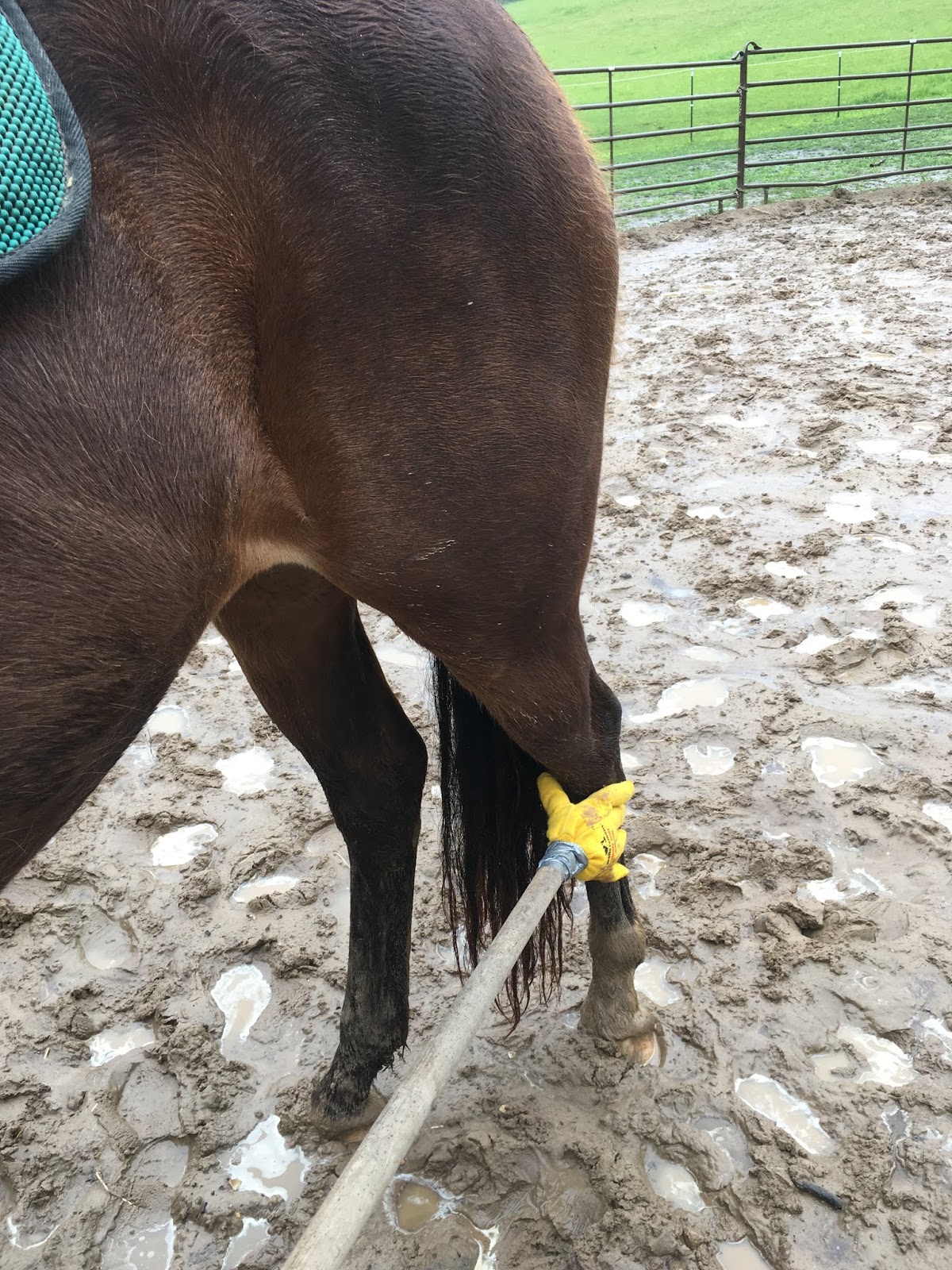
Do you have a horse that is overly sensitive to touch?  Maybe just touching certain areas causes them to bolt or kick.  A dummy hand is a safer way to desensitize these types of horses while keeping the handler in a safer position.  Dummy hands can be especially useful for desensitizing the hindquarters and hind legs.

Making one is super simple, and you probably already have all of the materials!  Here's how to do it:

MATERIALS:
  • Sturdy pole, like a broom handle
  • Glove
  • Plastic bags
  • Ductape

PUTTING IT TOGETHER:

Stuff the plastic bags into the glove.  Make sure to get the bags into the finger tips.  Keep stuffing the glove until it is stiff.  Tape the glove securely onto one end of the broom handle.  That's it! Your dummy hand is complete.

HOW TO USE IT:

Allow your horse to sniff the dummy hand first.  Then, stroke your horse with the dummy hand on a spot they are comfortable with (typically the shoulder is a good place to start).  Hold on to your horse's lead rope as you work, but allow some slack in the lead.  Make sure your lead is short enough, however, that they are not able to swing their hindquarters towards you to kick.  Gradually move across their body to new areas, stroking until they are relaxed and comfortable.  Make sure to use the dummy hand on both sides!


Thursday, January 16, 2020

**EARLY BIRD SPECIAL**

Book your training dates by April 15th and save $50 on 30 days of training!  A non-refundable deposit* must be received by this date to reserve your horse's training spot and to receive the discount.

**Now booking for 2020.  First available date is May 2nd**

Services include:

*Colt Starting

*Behavioral Correction

*Tune-Ups

*Pattern Starting (Poles, Barrels, etc.)

*Trail Training (Crossing water and bridges, traffic desensitization, etc.)

Training packages are available in 30-day increments (a shorter duration may be available depending on the service requested) and includes feed and board.  Fee is typically $625 for 30-days.  Potential clients are welcome to see where their horse will be staying and meet me in person before bringing their horse to me, if they wish.  Ask about my discounts for having more that one horse in training at a time.


If your horse is feeling spunky, book a spring tune-up!
*The non-refundable deposit is $50 for 30-days, and $75 for 60-days.  If the original date reserved does not work, a different date may be scheduled (provided I have an opening).  If I am unable to take your horse due to unforeseen circumstances on the agreed upon date and an alternate date cannot be arranged, the deposit will be refunded.

Training Horse Profile: Wrigley the Mustang

  Training Goals: Start under saddle Continue to build confidence and trust Wrigley is a four-year-old mustang that was recently acquired by...